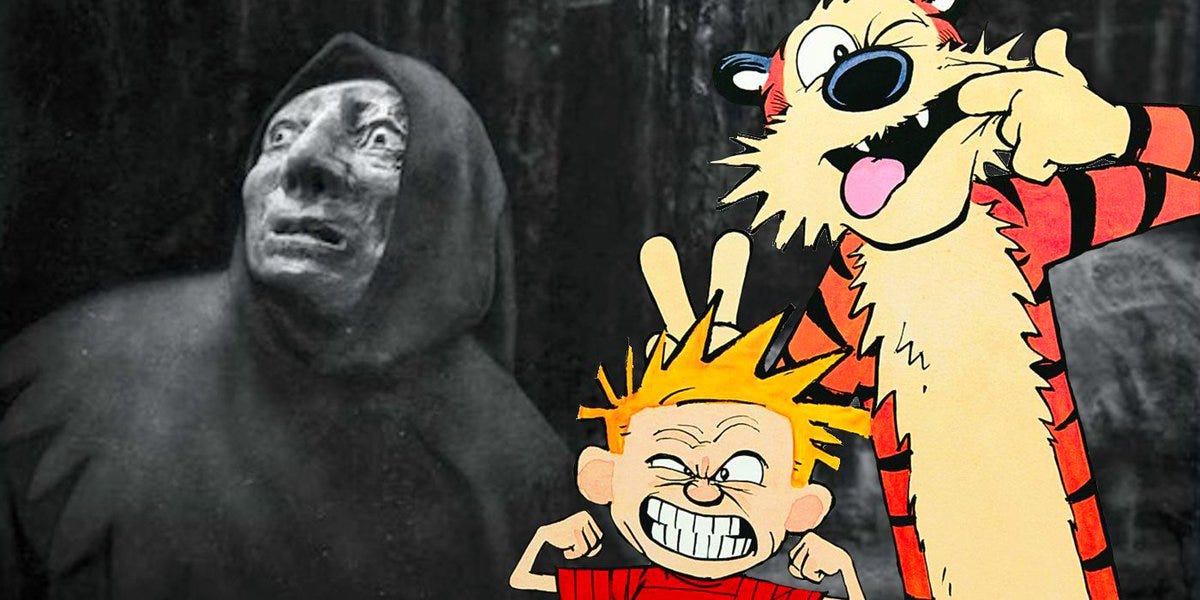
In February of this year, it was announced that Bill Watterson, responsible for creating the joy that is Calvin & Hobbes, would be releasing a new illustrated story titled The Mysteries within the year. Gothic illustration in black and white were released to the public shortly after the announcement. After anticipating the release of this story for eight months, I was finally able to pick up a copy a few days after the book’s release earlier this month.
When I walked into the small town Barnes & Noble, the associates were surprised that the writer of the colorful story had taken such a different approach to his new story. The girl at the register stating to me that this book has a very different vibe from the colorful and fun-loving Calvin & Hobbes. Frequently overlooked is that the loved duo of Calvin & Hobbes are named after fiery theologian John Calvin and philosopher Thomas Hobbes. On the surface, it may appear that the cartoonish expression of Watterson’s earlier works lack sophistication, but there are intentional subconscious themes to be extracted from the adventures of a boy and his pet Tiger.
With his return to comic writing, Watterson aims to his now grown up audience, revealing personal insights to current events such as war, media, and science. Watterson collaborated with John Kascht, known for his reinterpretation of caricatures, creating vivid black and white illustrations that make the Dark Age inspired gothic tones come to life.
Throughout the book, Watterson emphasizes the monotony of life. Watterson frequently uses the lenses of common citizens to show changes to the world around them, but still the world seems out of their control. Indeed, people are mesmerized by the world and the constant changes around them. The common folk in the book are captivated by strong characters who use the media to bring both senses of relief and anxiety to the commoners, which is an insight to Watterson’s current distaste with media polarization.
Lastly, Watterson appeals to the current events of global health and environmental emergencies, explaining that no matter how much we uncover about The Mysteries of the world around us, if we choose to ignore them, we may be doomed. His conclusion is not one of courage or inspiration. Instead, Watterson commits to the fact that humanity is a small part of the progressing universe, and regardless of humanity’s decisions, time will progress.
For someone who grew up on the comedic & colorful Calvin & Hobbes, Watterson’s drastic change to showcase to the public his fears of the future is a leap from the nonchalant stories of the boy and his animal friend. The Mysteries is a welcomed progression of Watterson’s career. Watterson still entertains his audience, but also leaves the reader to consider thoughts on the fragility of life.