The current wave of AI innovation is redefining how value is created and captured across the software stack. One of the clearest signals of this shift is the rise of acquisitions focused on open source developer tooling. For example, OpenAI acquired Astral, the makers of the uv Python package manager, last month with terms not publicly disclosed. Earlier, Anthropic acquired Bun in December of 2025, the Rust-based JavaScript runtime, in a prior transaction during the same year they released their ever popular Claude Code product. These transactions often appear modest in financial terms, yet they carry outsized strategic importance for the companies involved.

At the center of this is a mismatch between price and impact. Open source projects and their associated talent are frequently acquired at valuations that do not reflect their long-term contribution to product roadmaps. Once integrated into large, well-capitalized organizations, these tools become foundational infrastructure for how software is built and increasingly co-created with agents.
Mispricing Developer Infrastructure
Traditional valuation frameworks struggle to capture the true value of open source software. Many of these projects generate limited direct revenue, rely on permissive licensing, and prioritize adoption over monetization. As a result, they often appear financially modest when evaluated as standalone businesses.
However, this view overlooks distribution. Open source tools that achieve widespread developer adoption become embedded in daily workflows. Acquirers recognize this gap. By purchasing these assets early, they gain control over critical layers of the developer stack at a cost that is low relative to the long-term strategic benefit.
OpenAI and Anthropic Case Studies
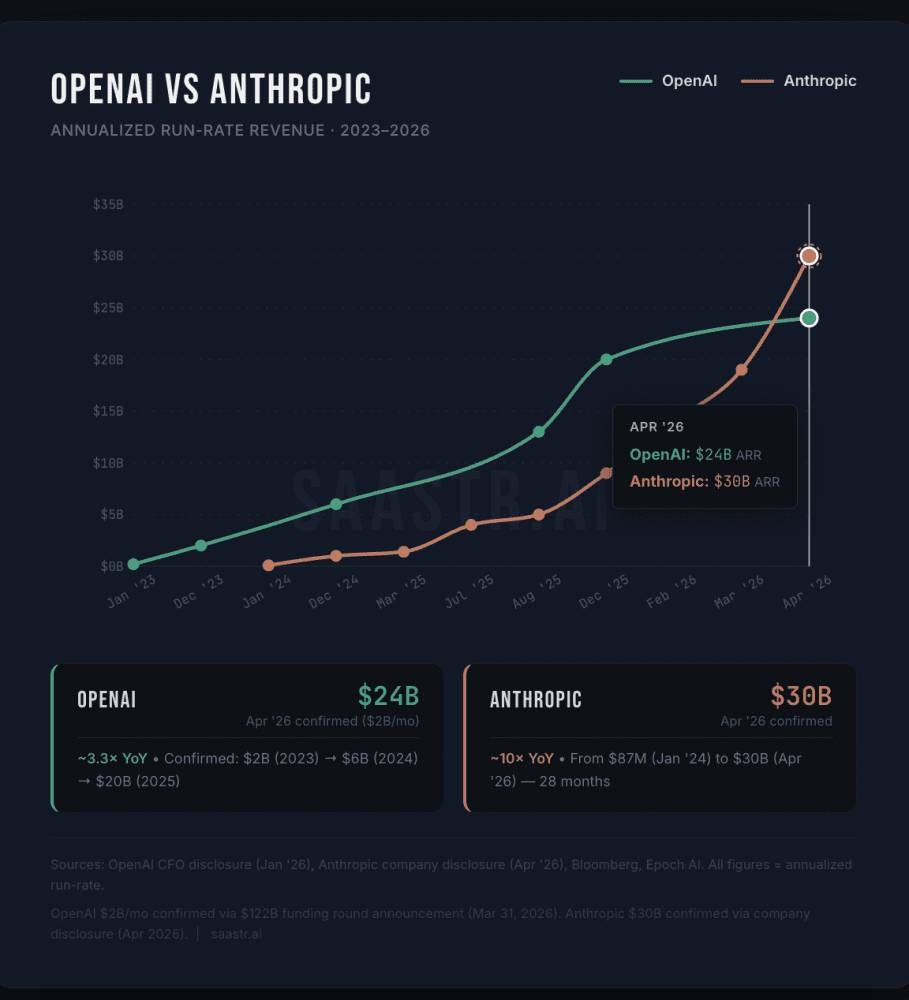
OpenAI and Anthropic are the fastest growing companies of all-time. No questions asked. There is clear market fit with AI tools used for programming.
OpenAI’s acquisition of Astral, the team behind the Python package manager uv, reflects the importance of owning the environment in which code is executed. uv gained rapid adoption by dramatically improving performance and simplifying dependency management. Integrated into product roadmaps and tools like Codex and ChatGPT, it can directly influence how humans and agents write, run, and iterate on code.
Anthropic has been able to catch up to OpenAI on revenue due to it’s conviction on coding tools being the “killer app” of the AI era. For a company focused on AI-generated code, owning the runtime environment enables tighter coupling between model output and execution. It reduces friction between generation and validation, a critical requirement for agent-driven systems.
OpenAI also acquired the talented creator of OpenClaw, Peter Steinburger, as they build out future product roadmaps. $100M+ acquihires were already made for model research talent. Now, these companies on rocket-like trajectories are competing for share and retention on product, with the willingness to pay for the talent to get it done.
Broader ecosystem moves such as NVIDIA’s release of NemoClaw during GTC, reinforces the trend. NVIDIA’s go-to-market strategy is aligned on giving developers free software in hopes that they will return a multiple on hardware purchases. Companies are competing not only at the model layer, but across the full developer experience stack.
Historical Precedent: Open Source as a Distribution Engine
This pattern is not new. Prior generations of technology companies have used open source tools as a way to win developer adoption at scale, often at little to no cost, and later monetize indirectly through infrastructure and platform spend.

Microsoft’s .NET ecosystem lowered barriers for enterprise developers, ultimately driving long-term consumption of Azure and related services.
Facebook’s release of React created a dominant frontend paradigm, expanding the pool of developers building complex web applications that rely on cloud infrastructure.
Vercel’s stewardship of Next.js simplified full-stack development, accelerating deployment patterns that naturally increase usage of hosting and edge infrastructure.
In each case, the open source tool itself was not the primary revenue driver. Instead, it acted as a distribution layer, embedding the company into developer workflows and influencing downstream spending decisions.
The current wave of acquisitions by AI companies follows a similar logic. This increases their strategic importance beyond traditional developer experience and into the core of software production.
A Continuum of Opportunity
The pattern extends across different stages of company maturity. Early-stage projects like Pydantic began as widely used libraries before evolving into commercial entities. More mature platforms like LangChain have evolved into core infrastructure for enterprise AI development, expanding beyond simple abstractions into full-stack orchestration, observability, evaluation, and deployment layers.
LangChain is increasingly used as a standard interface for building production-grade AI applications. Its newer offerings provide enterprises with structured ways to manage prompts, coordinate multi-step agent workflows, integrate with proprietary data sources, and monitor system performance in real time. This moves it from a developer convenience to an enteprise-grade system of record for how AI applications are constructed and operated.
Each stage represents a potential acquisition target. While valuations may increase with maturity, the underlying dynamic remains consistent: adoption precedes monetization, and strategic value exceeds standalone financial performance.
Strategic Implications
For large technology companies, these acquisitions provide several advantages. They enable vertical integration across the development stack, embed proprietary capabilities into widely used workflows and products, and create distribution channels that are difficult for competitors to displace. Not to mention, it’s a competitive advantage to acquire entreperneurial talent from these projects as companies continue research and development on their moats around model and product distribution.
In the End
Open source M&A in the AI era reflects a deeper structural change in the software industry. Developer tools are no longer peripheral utilities. They are becoming core infrastructure for how intelligent systems are created and deployed. As a result, acquisitions that appear inexpensive in the present may return great multiples as companies seek to win and retain the hearts and minds of developers with deep pockets.